
World of Warships explained: a practical guide for new and returning captains
This page is an advertising feature. The buttons below are partner links: if you create an account through one of them, BRSM s.r.o. may be paid a commission by the advertiser. That costs you nothing and does not change the offer you get. It also does not change what is written here — nobody pays for a favourable sentence, and the corrections further down were made against the advertiser's commercial interest. Our editorial policy sets out the rules we work to.
World of Warships is a free-to-play naval combat game for Windows PC, published by Wargaming, in which teams of players fight each other in warships drawn from the first half of the twentieth century. This guide explains how the game is put together — classes, gunnery, armour, spotting, tiers and the economy — so that you can decide whether it suits you before you install nineteen gigabytes of it.
Contents
- What the game actually is
- What it is not
- The five ship classes
- Shells, fires and flooding
- Armour, angling and the citadel
- Spotting and concealment
- Consumables
- How a battle runs
- Game modes
- Tiers and matchmaking
- Progression, money and fairness
- Getting started well
- Five beginner mistakes
- Is it worth your time?
- Sources and corrections
What the game actually is
World of Warships is a team-based online game. Two teams of ships meet on a map of open water, islands and capture areas, and fight until one side is destroyed, reaches a points target, or leads on points when the clock runs out. Control is third-person: you steer the ship, aim the guns with the mouse, and manage a small set of timed abilities. There is no direct control of individual turrets or crew, and no campaign to play through — the battle is the unit of the game.
Wargaming released the game for Windows PC on 17 September 2015, and it has been updated continuously since. Two things are worth knowing before you go looking for it:
- The console game is a different game. World of Warships: Legends runs on consoles and has its own ships, progression and balance. Guides written for the PC game do not translate cleanly to it.
- Which version you get depends on where you are. Since 2022, the Russian-language version has been operated by a separate company under a different name, following the split announced by both parties. Regional availability, payment options and account rules are set by the operator for your region, not by this site.
The game costs nothing to download and nothing to play. Money buys premium ships, cosmetic items, the in-game currency called doubloons, and a subscription-style account bonus that increases how fast you earn credits and experience. None of it is required to play, and all of it is discussed honestly in the economy section below.
Partner link. If you register through it, BRSM s.r.o. may receive a commission from the advertiser. It costs you nothing extra and changes nothing about the offer you receive.
What it is not
Three claims you will see repeated, and what is actually true
“Every ship is a real vessel, recreated accurately.” Not so. A large part of the line-up — especially at the higher tiers — consists of designs that were drawn but never built, ships that were laid down and cancelled, and in some cases invented refits. Many ships are real and carefully researched. Many others exist only on paper, and a few are outright fictional.
“It is a naval simulator.” It is not. Gun ranges, shell flight times, turning circles, spotting distances and repair mechanics are all tuned for playable matches of roughly twenty minutes. A ship that sails at 30 knots in the game does not travel a real 30 knots across a real sea; the scale is compressed deliberately.
“It is set in the Second World War.” Only in part. The line-up runs from pre-dreadnought-era hulls through the inter-war treaty period and the Second World War, and on into late-1940s and 1950s designs that never saw action. There is no historical campaign, and battles routinely pit nations against each other that never fought.
None of this is a criticism of the game — a strict simulator would be unplayable in a twenty-minute match. But if the appeal you are being sold is “historical accuracy”, calibrate that expectation now rather than after the download.
The five ship classes
Every ship belongs to a class, and the class determines what you are for. New players who lose interest usually picked a class that does not match how they like to play, rather than a bad ship.
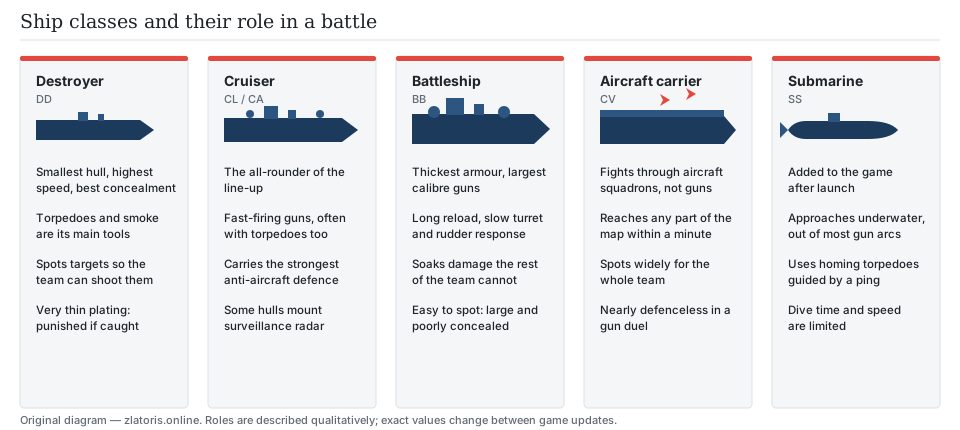
Broadly: destroyers are fast, nearly invisible and made of paper; they decide the early game by taking the capture areas and telling the team where the enemy is. Cruisers are the flexible middle — quick-firing guns, real anti-aircraft defence, often torpedoes, and on some hulls a surveillance radar that finds hidden destroyers. Battleships carry the thickest armour and the largest guns, reload slowly and punish mistakes severely, including their own. Aircraft carriers fight through squadrons of aircraft and spot for the whole team, but have almost no answer to a ship that gets close. Submarines, which entered random battles in early access from late 2022 with further national lines following through 2023, approach underwater and attack with torpedoes guided by an acoustic ping, limited by how long they can stay down. They remain the most argued-about class in the game.
A fuller breakdown of what each class does, and which one to learn first, is on our ship classes page.
Shells, fires and flooding
Gunnery is where most of the depth sits. You choose between two main shell types, and choosing badly is the single most common reason a new player's damage numbers stay low.
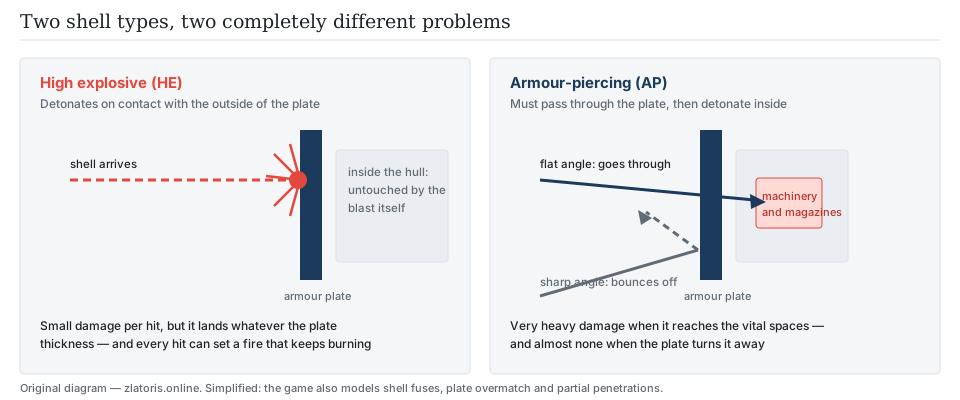
High-explosive shells burst on the outside of the target. They do a modest amount of damage regardless of the armour underneath, chip away at superstructure and gun mounts, and each hit has a chance to start a fire. Fire is not a scratch: it burns for a set period and takes a meaningful share of the ship's health with it. Several fires at once will kill a battleship that never took a penetrating hit.
Armour-piercing shells have to defeat the plate. If they pass through and detonate inside the hull, the damage is far larger — and if they detonate inside the armoured box protecting the machinery and magazines, the “citadel”, the damage is enormous. If they strike at too steep an angle they ricochet and do nothing. If they pass clean through a thin destroyer without arming, they do very little. Choosing armour-piercing against a properly angled battleship is how new players spend four minutes achieving nothing.
Torpedoes are the third weapon. They are slow, visible once spotted, and devastating: a torpedo hit can cause flooding, which drains health over time in the same way fire does. Both fire and flooding can be stopped with a consumable, but that consumable has a cooldown — which is why experienced players deliberately set a second fire while your damage control is on cooldown.
Armour, angling and the citadel
The armour model is the reason two players in identical ships can have completely different results. Armour is not a single number; it is a set of plates of different thicknesses, and what matters is the angle at which a shell meets them.
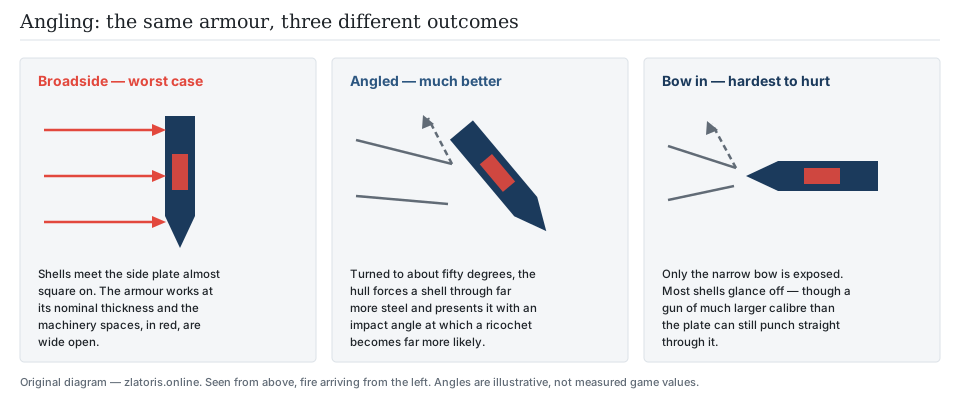
Three rules carry most of the value:
- Never show your full side to a battleship. A flat broadside at close range is an invitation to a citadel hit, and a citadel hit can remove a third of your health in one salvo.
- Angle, and keep angling. Turning the bow towards the enemy raises the effective thickness of everything they are shooting at and makes ricochets far more likely.
- Very large guns ignore thin plating. A shell will punch straight through armour that is thin relative to its calibre, regardless of the angle. This is why angling saves a cruiser against another cruiser but not always against the largest battleship guns — and it is the mechanic most worth checking in current patch notes, because the exact threshold is a game constant that the developers can change.
Most destroyers have no citadel at all, which is why they take consistent, survivable damage from armour-piercing fire rather than sudden catastrophic hits — and why shooting high explosive at them is usually the better choice.
Partner link. If you register through it, BRSM s.r.o. may receive a commission from the advertiser. It costs you nothing extra and changes nothing about the offer you receive.
Spotting and concealment
You cannot shoot what you cannot see, and the rules that decide who sees whom are the most important rules in the game. Every ship has a detection range. You become visible to the enemy team when an enemy ship or aircraft comes within yours.
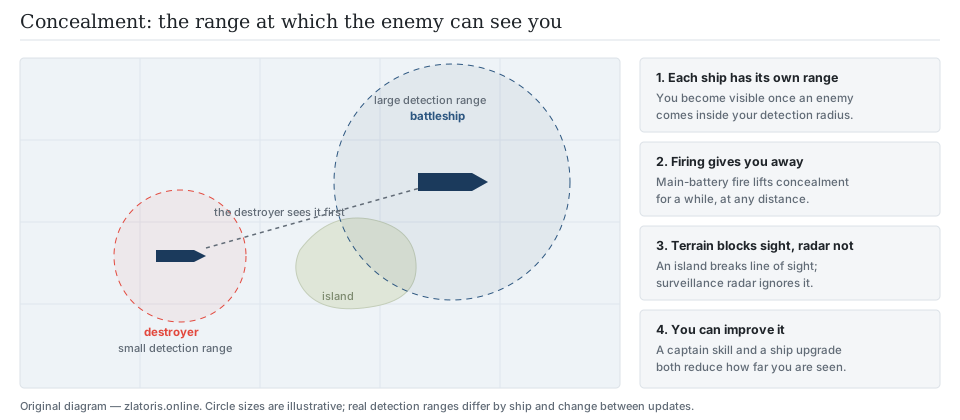
The consequences run through everything. A destroyer with good concealment can sit inside a battleship's detection range, see it perfectly, and remain invisible itself — which is why destroyers decide the opening minutes. Firing your main guns lifts your concealment for a period, so every salvo is a decision. Islands break line of sight, which makes terrain a weapon. Surveillance radar, carried by some cruisers and a few destroyers, ignores line of sight entirely for its duration, which is why a radar cruiser sitting behind an island near a capture area is such a problem for the other team.
Concealment can be improved: a commander skill and a ship upgrade both reduce the range at which you are detected, and the difference between a stock destroyer and a fully specified one is large enough to change how the ship plays.
Consumables
Each ship carries a small set of timed abilities on cooldown. Learning which ones your ship has, and holding them rather than pressing them the moment something happens, is most of the gap between a mediocre and a good player.
| Consumable | What it does | Typically carried by |
|---|---|---|
| Damage Control Party | Extinguishes fires and stops flooding, and repairs disabled modules, for a short window | Every ship |
| Repair Party | Restores a portion of lost health over time | Battleships, many cruisers, some destroyers |
| Smoke Generator | Lays a cloud that blocks line of sight | Destroyers, some cruisers |
| Hydroacoustic Search | Detects torpedoes and nearby ships at short range, through smoke | Cruisers, destroyers |
| Surveillance Radar | Reveals ships within a radius regardless of line of sight, for a short time | Some cruisers and destroyers |
| Engine Boost | Temporary increase in speed | Destroyers, some others |
| Defensive AA Fire | Sharply increases anti-aircraft damage for a short period | Many cruisers, some battleships |
How a battle runs
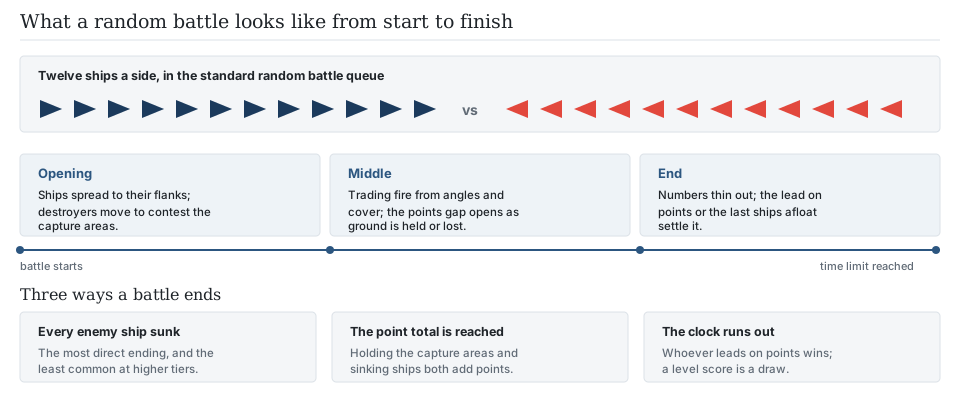
The standard random battle puts twelve ships on each side. The opening minutes are about position: destroyers push towards the capture areas, cruisers take up supporting ground behind cover, battleships settle into firing positions that they can angle from. The middle of the match is an exchange — damage traded, ground held or given up, the points gap opening. The end is usually decided by whoever still has ships on the board and a lead on points when the clock runs out.
A battle ends in one of three ways: every enemy ship is sunk, one team reaches the points target, or time expires and the side with more points wins. Points come from holding capture areas and from sinking ships, which is why a team that wins every gun exchange can still lose by ignoring the objectives — an outcome new players find baffling and veterans find routine.
Game modes
- Co-op battles — against bots. The right place to learn a new ship without costing eleven other people a match.
- Random battles — the main mode, twelve a side, mixed tiers.
- Ranked battles — a seasonal competitive mode with smaller teams and a ladder of ranks.
- Clan battles — organised team play in a clan-based season.
- Operations — scripted cooperative scenarios with objectives, played against the computer.
- Brawls and event modes — short-lived formats with their own rules, run periodically.
Which modes are running at any moment is decided by the current update. Only co-op and random battles are permanently available.
Tiers and matchmaking
Ships are ranked in tiers from I to X, with a small group of “superships” placed above tier X. The queue usually matches you against ships within about two tiers of your own, which means you will regularly be the smallest ship in the battle.
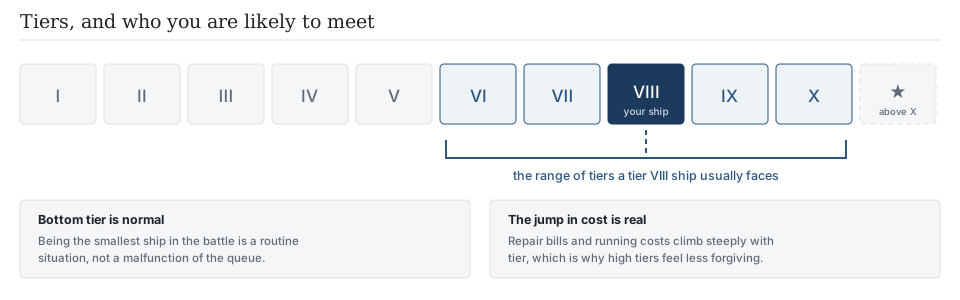
Two consequences matter for a new player. First, being bottom tier is normal, not a fault: the answer is to play a support role that match rather than trying to duel ships two tiers above you. Second, the running costs climb steeply with tier. A bad battle in a high-tier ship can cost more in repairs than it earns, which is why players who rush to tier X often find themselves unable to afford to play it. Tiers V to VII are where most of the game's value sits for a newcomer.
Partner link. If you register through it, BRSM s.r.o. may receive a commission from the advertiser. It costs you nothing extra and changes nothing about the offer you receive.
Progression, money and fairness
This is the part that deserves the most honesty, because it is the part most often described inaccurately — including in an earlier version of this page.
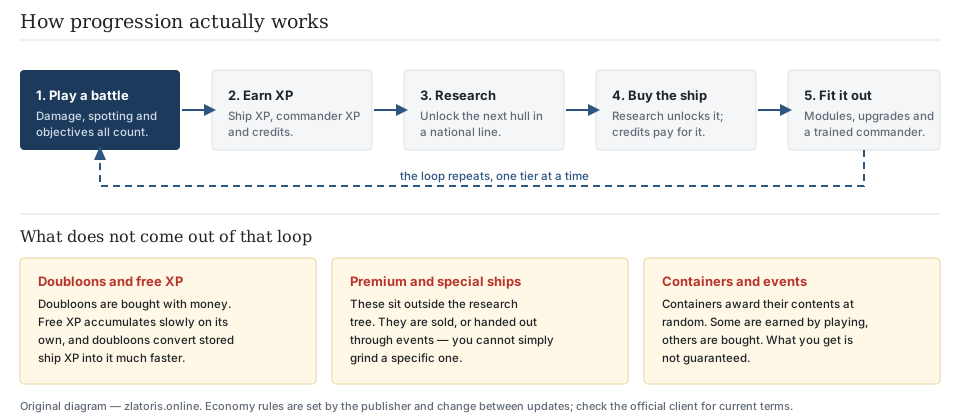
The research loop is straightforward. You play a battle; you earn ship experience, commander experience and credits; you spend experience to research the next ship in a national line and credits to buy it; you fit it with upgrades and a trained commander; you play it. Every ship in the research tree can be reached this way without spending money.
What sits outside that loop is where money enters:
- Premium and special ships cannot be researched. They are sold for money, or distributed through events, bundles and containers. If you want one specific premium ship, playing more will not reliably get it for you.
- Doubloons are bought with money and convert stored ship experience into free experience, which can be spent anywhere in the tree. In other words, money buys time.
- The premium account bonus increases earnings — credits and experience — rather than combat performance.
- Containers award their contents at random. Some are earned by playing, some are sold. What you receive is not guaranteed, and that is worth knowing before you spend.
Is that pay-to-win? Not in the crude sense: premium ships are balanced to sit alongside researched ships of the same tier rather than above them, and no purchase gives a straightforward statistical advantage over a player who has not paid. But money buys progression speed, access to ships that cannot otherwise be obtained, and a better economy. Calling the game “not pay-to-win, everything can be earned” is inaccurate, and we are not going to print it.
Getting started well
- Start low, not high. Tiers III to V teach the mechanics with cheap repair bills and forgiving opponents.
- Learn one class first. Cruisers teach you the most about how the game works; destroyers teach the fastest but punish hardest.
- Take new ships into co-op once before their first random battle.
- Check the system requirements on the official site before downloading. The game is not demanding by modern standards, but the requirements are published by the developer and change over time, so read them at source rather than trusting a figure in an article.
- Set a spending rule before you spend anything. The game is designed to be played for free indefinitely; decide in advance what, if anything, it is worth to you.
Five beginner mistakes
- Sailing in a straight line. Shells take seconds to arrive and enemies aim where you will be. Change speed and heading, constantly.
- Showing your side. Turning broadside at close range in front of a battleship ends the battle for you in one salvo.
- Firing high explosive at everything, or armour-piercing at everything. The shell type has to match the target.
- Pressing damage control at the first fire. The next two fires are the ones that kill you.
- Ignoring the capture areas. Points win battles; damage numbers do not.
Is it worth your time?
If you like slow, positional, thinking games where a good decision three minutes ago wins you a fight now, it is one of the best things in its genre, and it costs nothing to find out. If you want fast action, precise historical simulation, or a game you can progress in quickly without spending, you will probably bounce off it. The honest test is cheap: install it, play twenty battles at tier IV or V, and see whether the slow tension appeals to you.
One thing to keep in mind. Everything above describes the game as it stood when this page was written. World of Warships is patched continuously — ships are rebalanced, consumables are retuned, modes come and go. Where anything here differs from the official client, the patch notes or the publisher's own site, the publisher's information prevails.
Partner link. If you register through it, BRSM s.r.o. may receive a commission from the advertiser. It costs you nothing extra and changes nothing about the offer you receive.
Sources and corrections
Sources
- The publisher's official site and in-client patch notes, for release information, current game modes, economy rules and system requirements.
- The in-game client itself — tech tree, ship panels and consumable descriptions — for class behaviour, consumables and progression, checked at the time of writing.
- Public announcements by Wargaming and by the operator of the Russian-language version regarding the 2022 separation of the two versions.
- Wargaming's update 0.8.0 notes (January 2019) for the rework of aircraft carrier control from the original real-time-strategy scheme to direct squadron control.
- Wargaming's release announcement for the Windows PC version, 17 September 2015.
We deliberately do not quote damage figures, detection ranges, reload times or ship counts. Those change with nearly every update, and a number that is right today is misinformation in four months. Where a number matters to you, read it in the client.
Corrections
An earlier version of this page made several claims that were wrong. They have been corrected, and we are listing them rather than quietly deleting them:
- It said every ship in the game is modelled on a real vessel with accurate dimensions and performance. Many ships are unbuilt paper designs, and the game's values are balanced rather than simulated. Corrected.
- It said battles are played in teams of ten. Standard random battles are twelve a side. Corrected.
- It said all ships can be earned through gameplay and that there is no pay-to-win environment. Premium and special ships are not researchable. Rewritten in full in the economy section.
- It said the game is set in the era of the Second World War. The line-up spans from the pre-dreadnought era to post-war designs. Corrected.
- The page was presented as a reader-submitted story. It was not one. That framing has been removed and the page now carries a named editor, a date and this corrections list.
Found something else that is wrong? Write to info@zlatoris.online and we will check it and publish the correction. Our corrections procedure explains how.
The illustrations on this page are original diagrams drawn for this article as SVG files. They contain no screenshots, no product artwork and no third-party images.